


14 Aug What Great Film Scores Teach Us About Library Music
It’s 2026, and score is doing more narrative work in film and television than it gets credit for. The industry’s move away from wall-to-wall orchestral cues toward restraint, texture, and silence isn’t a stylistic trend — it’s a shift in how composers, and directors, think about audience attention.
It’s worth examining what’s actually happening in a few of the last decade’s most effective scores, because those same creative principles explain where production music fits into a professional post-production workflow — especially when a bespoke cue isn’t the right tool for the job.
What Modern Scores Are Actually Doing
The best film and television scores aren’t memorable because they’re complex or constantly present. They’re memorable because every creative decision serves the story. Whether it’s instrumentation, texture, silence, or restraint, today’s leading composers are making deliberate choices that shape how audiences experience a scene. A handful of influential scores make the pattern clear.
Interstellar (Hans Zimmer) — The pipe organ choice does more than scale; it flattens harmonic movement into something closer to a drone, which is what lets the strings carry emotional weight without competing for space. The build is slow because the payoff depends on it.
The Social Network (Trent Reznor & Atticus Ross) — We’re talking processed piano and low-frequency drone over conventional scoring. It’s arguably the score most responsible for normalising ambient, sound-design-adjacent underscore in prestige drama — a texture now standard in tech, finance, and true-crime work.
Black Panther (Ludwig Göransson) — Göransson spent time researching West African instrumentation and vocal traditions before writing a single note, then integrated it into a conventional blockbuster structure rather than using it as colour. The result reads as specific rather than generic — this is the difference between a score that supports a world and one that just supports a scene.
Joker (Hildur Guðnadóttir) — This is a single-instrument approach in a genre that usually reaches for scale. The cello carries tonal ambiguity that the script itself avoids stating outright — the score is gently doing narrative work, not just mood-setting.
Gravity (Steven Price) — Near-total silence as a structural choice, not an absence. The crescendos land because Price earns them with real negative space. This is harder than it sounds when a mix has to work in a 5.1 or Atmos deliverable.
What unites all five is restraint used on purpose. None of these composers reached for scale by default — they reached for whatever the story actually needed, and trusted that a well-placed texture or a stretch of silence could carry more weight than a full cue. That same instinct — using the right tool for the moment rather than the biggest one available — is exactly what separates a production that sounds considered from one that just sounds busy. And it’s the same instinct that should govern the choice between a commissioned score and a library track.
Where Production Music Fits Into a Real Workflow
None of this means every production needs a Zimmer-sized budget or an original score from beginning to end. If anything, these examples illustrate what effective screen music is actually trying to achieve: supporting story, creating emotional texture, and knowing when not to compete for attention. A commissioned score is one way to do that. A well-chosen library cue, used in the right spot, is doing the same job.
That’s why the conversation shouldn’t be framed as production music versus bespoke composition. In professional post-production, they’re complementary tools — and in practice, very little of a finished cut relies on hero cues alone. Editors, music supervisors, and post teams still need high-quality music for temp scores, transitions, factual programming, trailers, and deliverables. That’s where a deep, well-produced, and intelligently searchable catalogue earns its place:
Temp tracks that actually hold up — A temp score built from generic stock cues often gets replaced out of necessity. One built from authentic, quality production music gives editors, directors, and composers a clearer target.
Secondary and transitional cues — Not every scene needs a commissioned theme. Background beds, scene transitions, and B-roll under dialogue are exactly where a strong library earns its keep without diluting the hero score’s impact.
Unscripted and factual production at volume — A season of unscripted or documentary work can run to dozens of hours of cut content on a schedule no composer is built to match cue-for-cue. In this space, a consistently high-quality, easy to search library is an absolute must.
Trailers, sizzles, and festival deliverables — Fast turnarounds with hard deadlines and no time to commission — this is where sourcing needs to be trusted, immediate and rights need to be unambiguous.
Multi-territory and multi-platform delivery — Clearance that holds up across broadcasters, streamers and territories without a rights conversation for every new distribution deal is a real time cost saved, not just a convenience.
What to Look for in a Catalogue at This Level
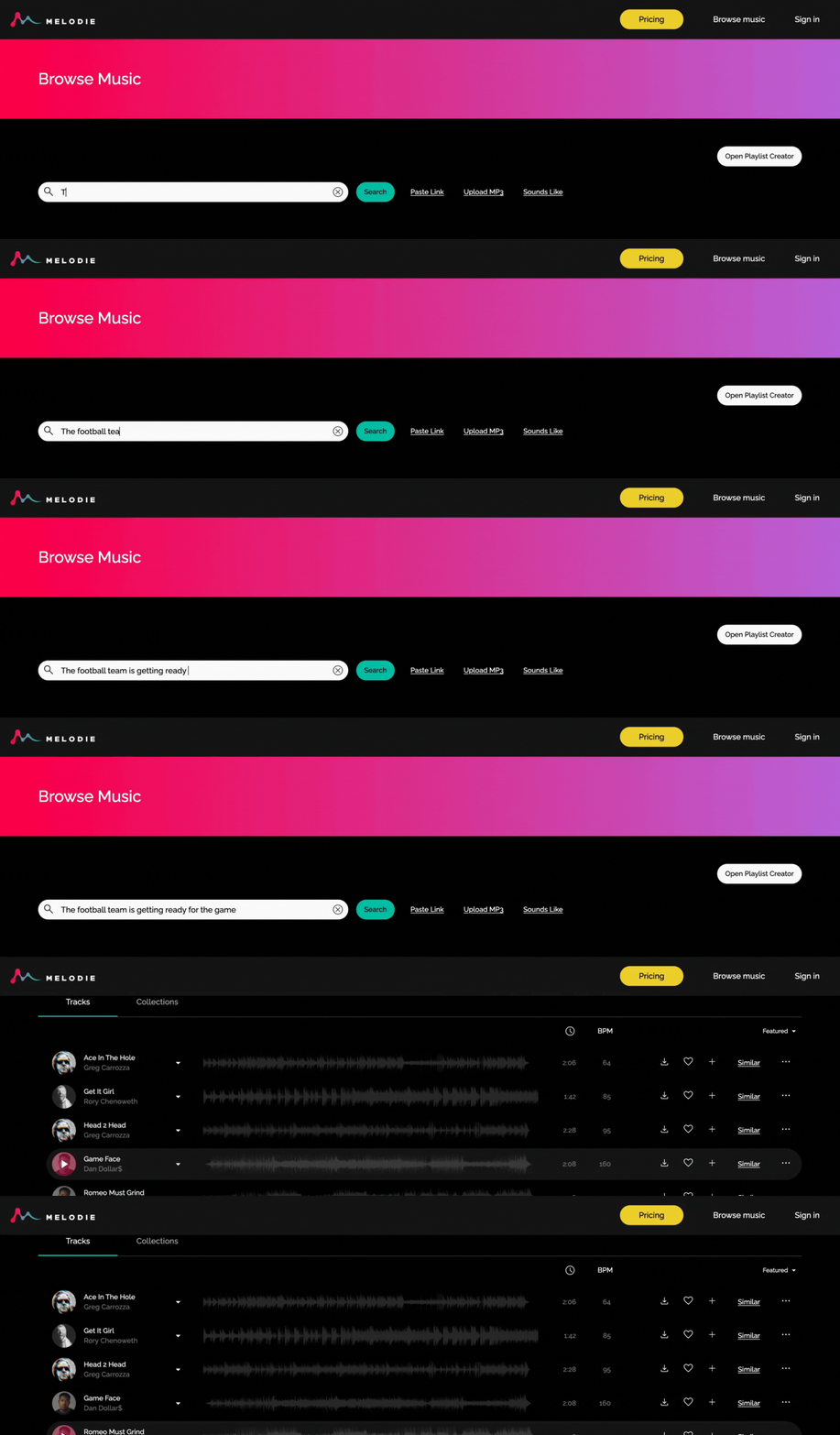
If library music is going to sit inside a professional post pipeline, it needs to behave like professional assets: pre-cleared rights, consistent quality and authenticity, stems and alternate mixes, and instant cue sheets with metadata clean enough to hand directly to a PRO or music supervisor (without spending a week in Excel).
That’s the standard Melodie is built to meet — 45,000+ original tracks and stems, searchable in real language and with clear, worldwide, perpetual licensing that’s built for this exact delivery pipeline.
If you’re creating a temp score, filling out a season, or need a Hollywood-grade trailer cue cleared by tomorrow, come and browse the full library at Melodie.
